
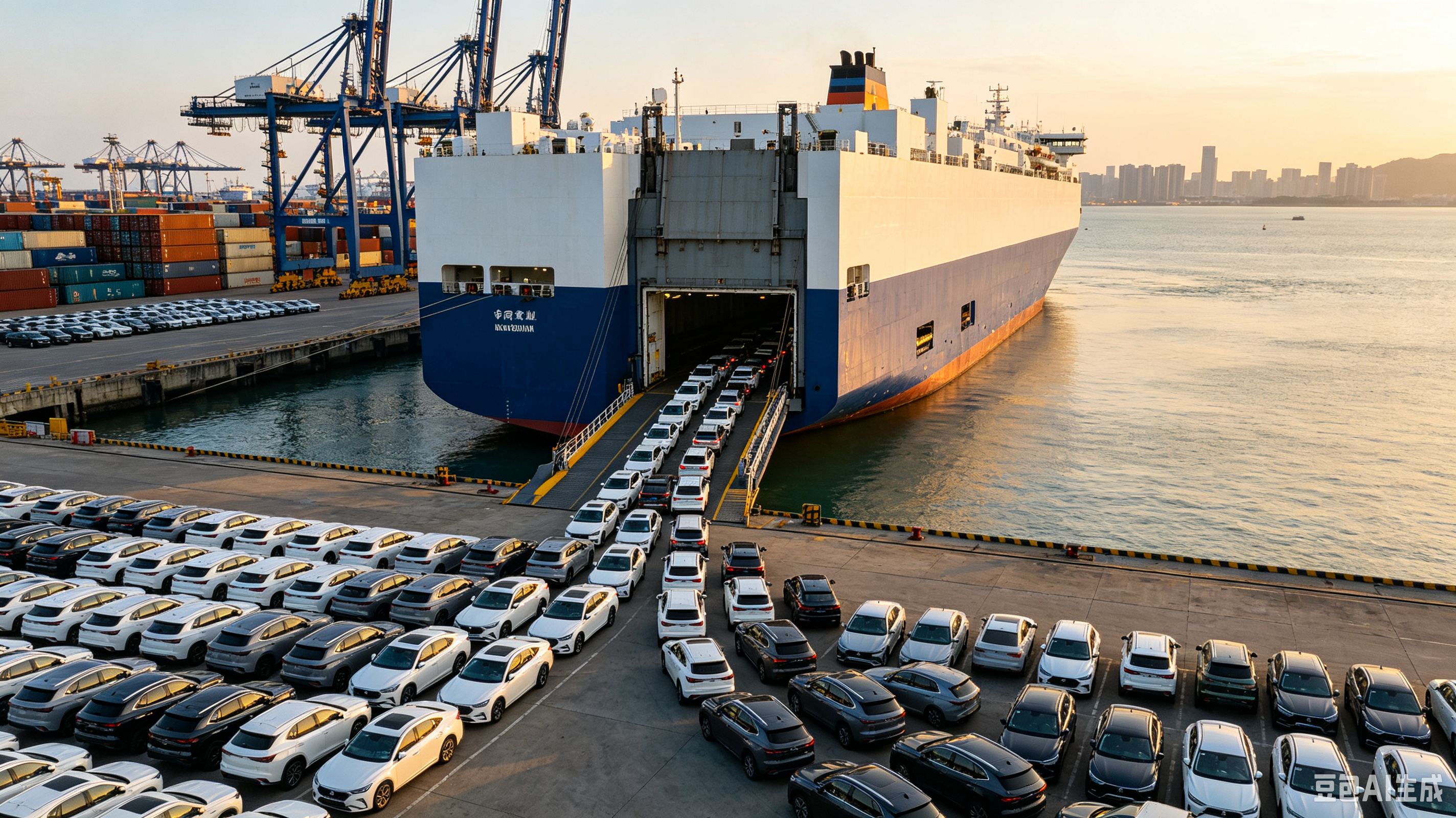
China's auto exports surge in first seven months, surpassing 1 million units for two consecutive months, marking a new phase in the global expansion of China's automotive industry.
**China Auto News** On 8 12, the China Association of Automobile Manufacturers released export data for automobiles from 2026 to 1-7. The data shows that China's total vehicle exports continue to grow at a high rate. Exports in 6 and 7 exceeded 100 units for two consecutive months, marking a new milestone where monthly exports have stabilized at over one million units. New energy vehicles have become the core engine driving export growth, while the export structure continues to optimize, with clear signs of simultaneous improvements in both volume and quality.
Data shows that from 1 to 7 of 2026, China exported **614 thousand units of complete vehicles, a year-over-year increase of **66.8%**. In 7 alone, exports reached 104.3 thousand units, up 0.6% month-over-month and significantly higher by 81.3% year-over-year. By category, passenger car exports totaled 535.4 thousand units from 1 to 7, up 72.5% year-over-year; commercial vehicle exports were 78.5 thousand units, up 36.1% year-over-year, with passenger cars continuing to lead in export volume.
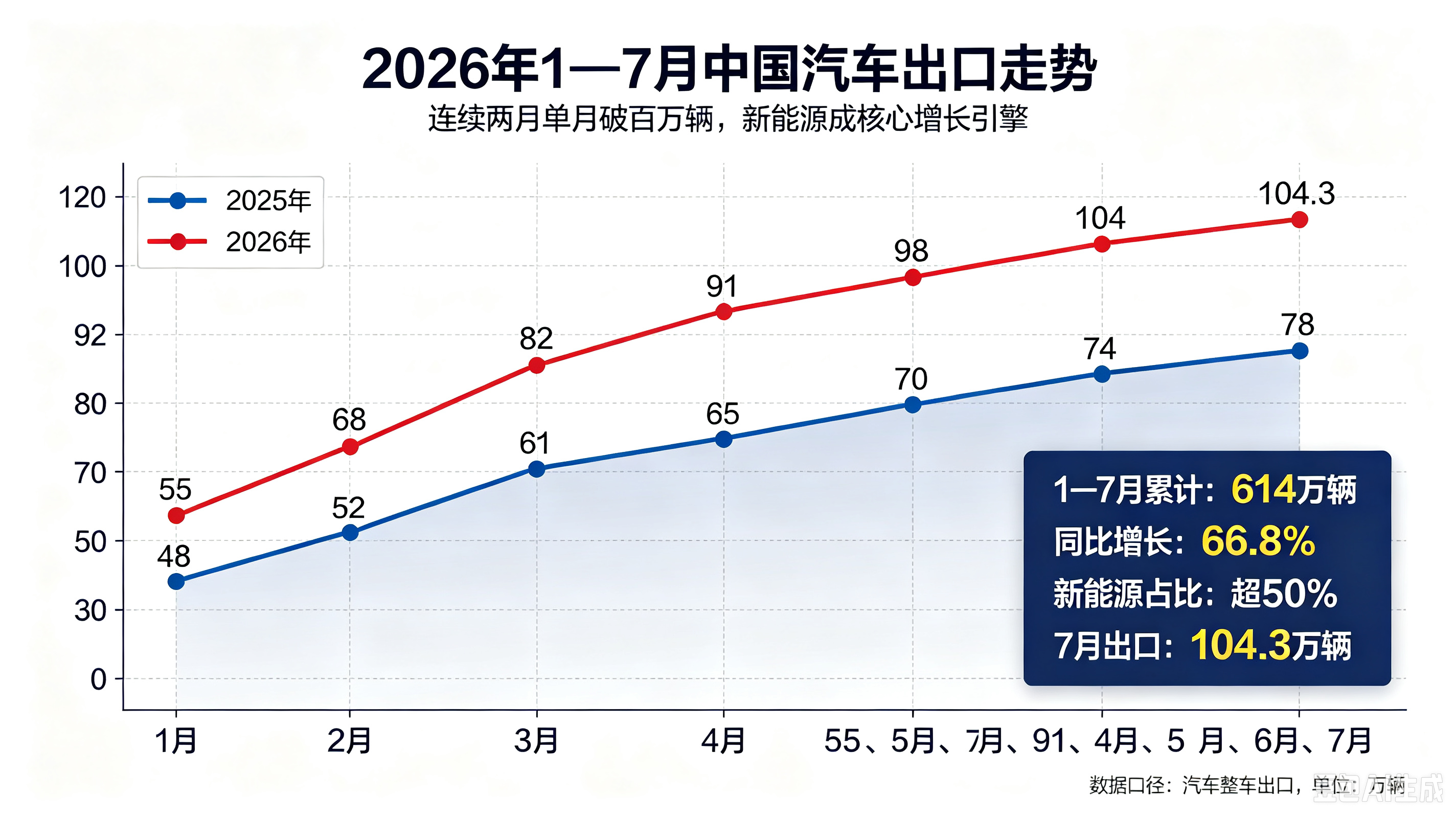
On the powertrain front, new energy vehicles (NEVs) are showing explosive growth in overseas markets. From 1 to 7, NEV exports reached **290.9 thousand units, a 1.2-fold year-over-year increase. Among them, passenger car exports totaled 284.2 thousand units, up 1.3 times year-over-year, while commercial vehicle exports reached 6.6 thousand units, growing by 23% year-over-year. In just 7, NEV exports hit 55.3 thousand units, representing a 1.5-fold increase year-over-year. For two consecutive months, NEVs accounted for over 50% of total vehicle exports, becoming the top export category. Both battery electric and plug-in hybrid models are driving demand across diverse global markets. Traditional fuel-powered vehicle exports also maintained steady growth, with 1-7 exports reaching 323.1 thousand units, up 36.2% year-over-year, further solidifying their position in overseas foundational markets.
From a corporate performance perspective, leading Chinese automakers continue to lead in export volume. From 1 to 7, Chery's cumulative exports reached 114.1 thousand units, up 71% year-over-year. BYD, SAIC, Geely, Tesla, and other companies also saw significant export growth. Many are accelerating their overseas localization strategies by establishing local production facilities and after-sales networks, transitioning from pure vehicle exports to localized operations to further enhance their competitiveness in global markets.
In terms of market distribution, China's automotive exports continue to diversify. Leveraging the economic and trade benefits of the Belt and Road Initiative, demand remains strong in Russia, Central Asia, the Middle East, Southeast Asia, Africa, Brazil, and other regions. Exports now reach over 210 countries and territories worldwide. At the same time, the value-added content of exported vehicles has steadily increased. No longer limited to entry-level economy models, the share of mid-to-high-end new energy vehicles is rising, while brand premium power continues to improve.
Beyond the rapid growth in new vehicle exports, used car exports are simultaneously undergoing standardized transformation. Benefiting from the implementation of the 2026 new policy on used car exports and the 180-day age eligibility rule, arbitrage-based exports of zero-mile near-new vehicles have been curbed. Exports of genuine used cars with existing inventory have grown steadily, creating a new dual-channel export landscape for both new and used vehicles, further unlocking the value of China's domestic vehicle stock.
Industry experts analyze that the strong export performance in the first seven months was driven by China's complete new energy vehicle (NEV) supply chain, enhanced product competitiveness, and rising demand for vehicle replacements in multiple overseas markets. However, the industry faces challenges including intensifying trade barriers, escalating international competition, and increased investment in local operations abroad. To achieve sustainable high-quality global expansion, Chinese automakers must shift from exporting products to exporting brands and services—establishing overseas parts warehouses, localized after-sales support, and financial service ecosystems.
Looking ahead to the second half of the year, with the arrival of traditional overseas sales peaks and new vehicle launches by automakers abroad, China's annual auto exports are poised to reach 10 million units. This will continue to serve as a key pillar in stabilizing foreign trade and help the Chinese automotive industry deepen its participation in global competition.